T4D AI Cohort 2 : Resuming the Avni AI journey
March 01, 2026 by Himesh R
A personal account of the T4D AI Cohort 2 in Rishikesh — exploring AI possibilities for Avni, forging new bonds, and finding moments of bliss.
The T4D AI Cohort 2 was conducted at Lemon Tree - Rishikesh on February 27-28, 2026.
With AI being seen as an equalizer by some whilst being viewed as a destabilizing force by others, we at Samanvay Foundation have reaped benefits by adopting AI in everyday tasks, be it Product development or Business outreach. Therefore, with the intention to learn more about technical possibilities and its impact on ground, we set off for the AI Cohort at Rishikesh, where Maha Lakshme and I represented Samanvay Foundation.
Contact, Meandering and Story narration
On reaching the Dehradun airport, I was able to catch-up with other participants of the AI-Cohort. I hitched a ride to the hotel with Vinay Sudhakaran, one of our mentors from the AI Cohort, where we got to know each other better, through our shared roots in Bengaluru. Also discussed travel plans in general and got a glimpse of Ganga and the Lit-up Janaki Sethu.
At the Lemon-tree hotel, I finally met with Maha after a very long time. We went out on a short walk through the winding gullies of Rishikesh, to visit Sai Ghat. Along the journey, Maha and I discussed our priorities for the duration of the AI Cohort as well as general approach towards AI stream development in Avni.
At dinner, we met the rest of the AI Cohort participants and organizers. We then had dry-runs for the Introductory NGO presentations, with Vinay as Judge. He felt my presentation was too technical and not suitable for the audience at hand. He gave an example narration without Jargons or Avni specific terminology, which seemed so much better. I gave it a few tries to emulate, but wasn't able to crack it then. We decided to give it a rest so that it would sink in.
Presentations, Resuming the AI journey and Forging new bonds
After a good night's sleep and some more practice with the dry runs, I felt my presentation preparation was as good as it could be.
We had some good presentations from the NGOs, amongst which Madhi and Inquilab Foundation's presentation stood out.
For our presentation, I felt that I executed the story narration of Avni and our AI Problem statement to the best of my abilities. And as per feedback too, it seemed to be well received.
We resumed our AI learning Journey with a session about AI Safety and Research done around Guardrails by Tattle. We also had a followup of a technical implementation of Guardrails done by Kaapi team.
After this we set off on our Mentoring session, to ideate on how to solve our AI problem statement.
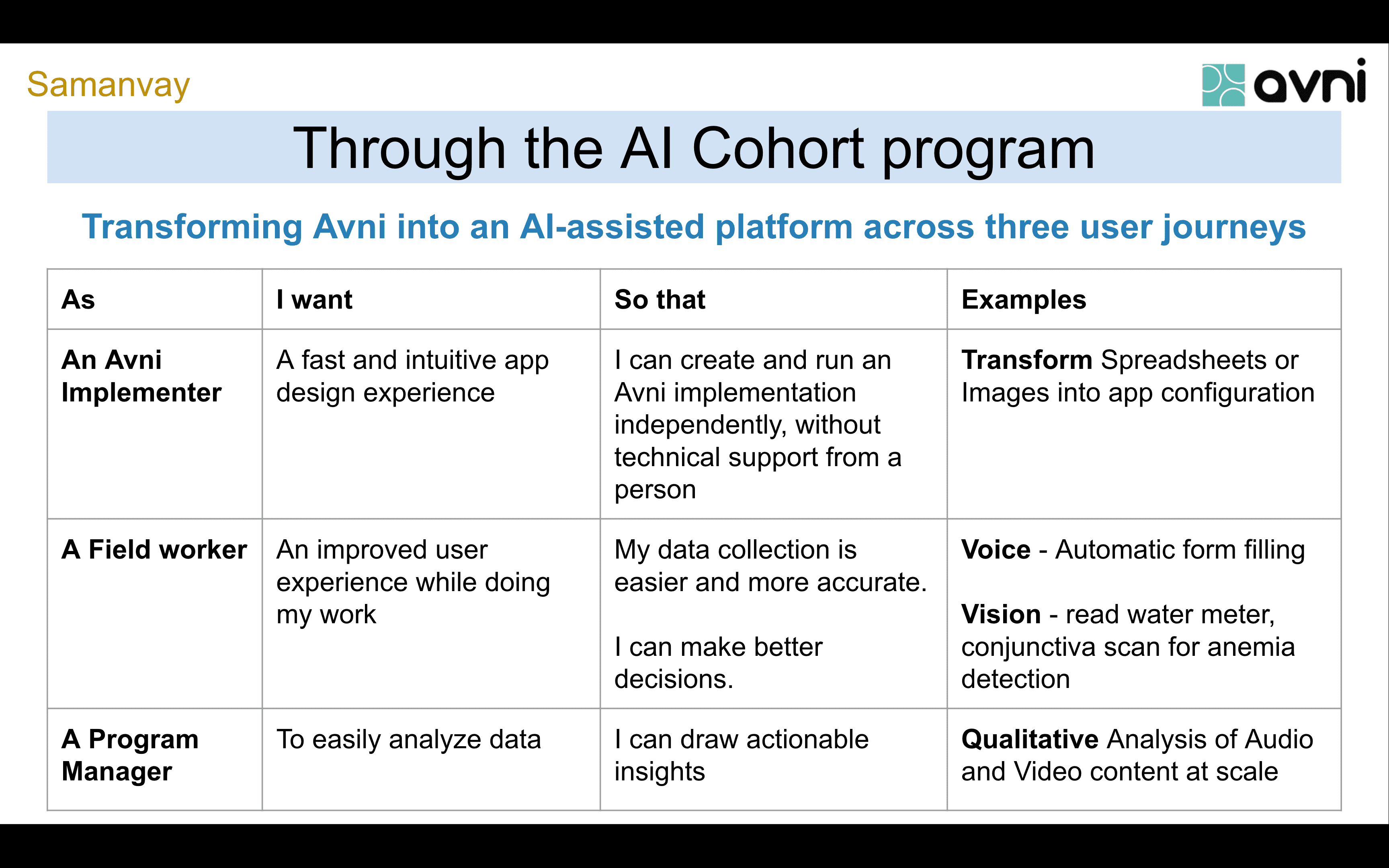
Maha engaged with our mentors on ideating on:
- How we could solve the Voice-to-text problem for auto-filling Avni forms?
- Analyzing the feasibility of offline SLMs for Avni Field APP integration
- Evaluating Google Cloud native support for building full fledged AI assistant for Avni.
Whilst I interacted with the Kaapi team on how to integrate
- Guardrails into Avni AI Assistant Dify Workflows
- Using latest AI tooling for defining Scoping documentation and generating Avni implementation Config.
I also spent time interacting with several other NGOs, from which I learnt about approach taken on some use-cases that were relevant to Avni:
- From Avanti-Fellows, I was excited about how they had earlier implemented a DB-chat AI assistant for querying a Database using simple english conversations.
- From Inquilab foundation, I learnt about outcome from their multi-model approach taken for AI based Idea Evaluator.
Finally, I also spent time sharing our learning and resources from building the Avni AI Assistant with the Glific team, who planned to implement a Dify based AI Assistant for their subscribers, as part of this AI Cohort.
A journey inwards and experiencing bliss
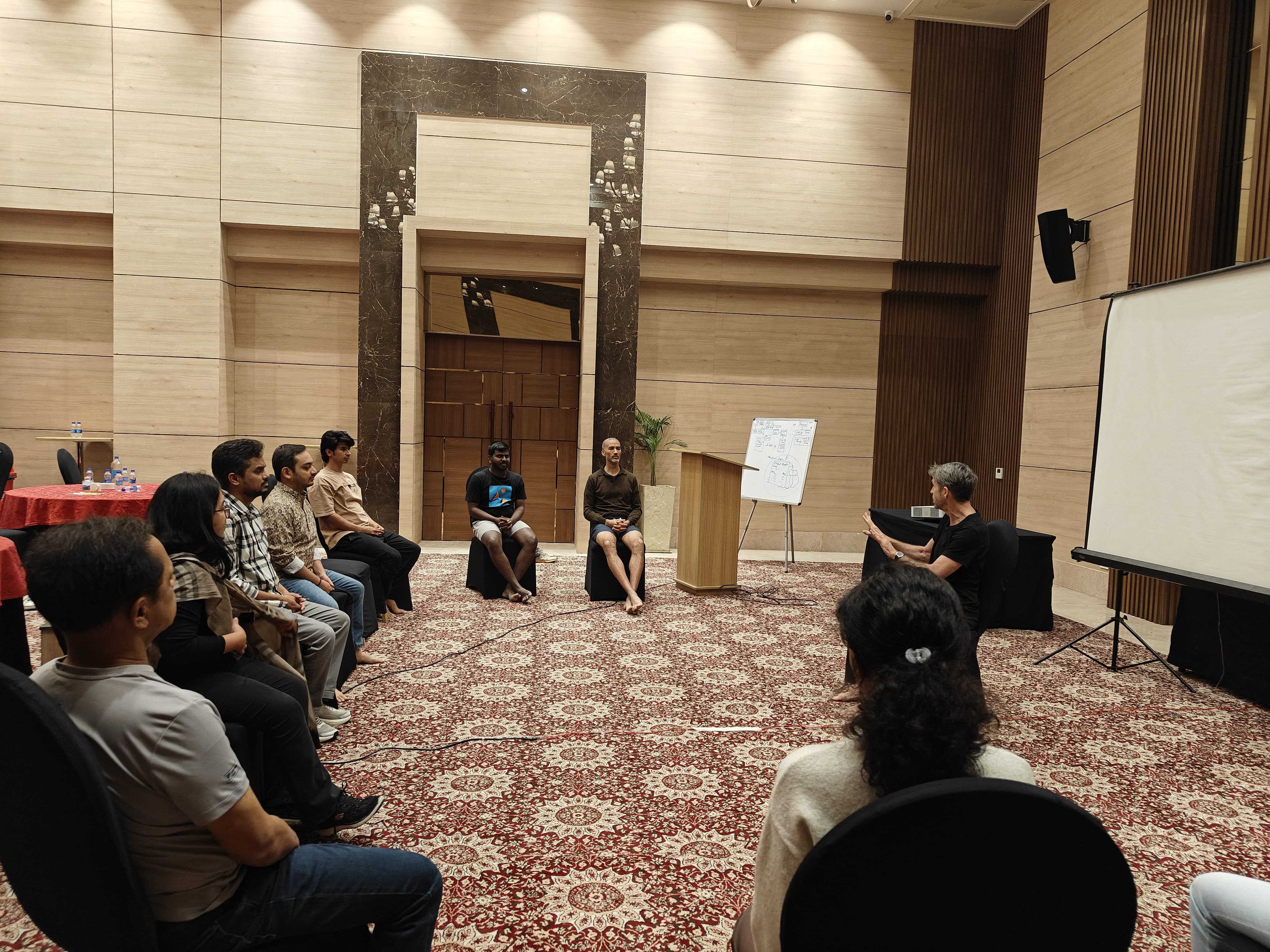
We ended the workday with an hour long Yoga session with Patrick, a yoga-practitioner who had recently fallen in love with India on his first visit here.
We had a lot of deep-exhalations through out the session and did some simple stretching exercise with our eyes closed. At the end, we did a seated yoga-nidra practice, which gave all of us present a deep-relaxation experience and helped us calm the chatter in our minds and soothe our subconscious. I experienced bliss on regaining awareness, which I hadn't experienced for a long time since I ended my Hatha yoga practice due to the Corona Pandemic.
After the yoga-practice we had a fascinating dinner time conversation with Lobo, Patrick and Pragnya about Veganism, Yoga-lineages and Indian Hospitality.
AI in Avni : The past, the present and the future
The day started with an early morning working session where Erica from Tech4Dev and I discussed progress we made as part of AI Cohort 1 and our plan for the current AI cohort.
I demonstrated Avni capabilities built as part of AI Cohort 1:
- The Avni Trial account Self-signup workflow
- The Avni Templates capability and
- The Avni AI Assistant
During the demo, we uncovered a few issues and brainstormed on their cause and possible corrective actions, which are as listed below:
- Template application : Not Intuitive and some of the templates failed on application
- AI Assistant : The responses were not always in the context of Avni Implementer, due to pollution of Knowledge Base with Developer Documentation. This seemed to have been caused due to semi-automation of Knowledge base refresh with Avni Readme, where we forgot to take away Avni Developer documentation content.
- General quality of AI features implemented, where we hadn't thoroughly tested what we had built.
Erica was appreciative of the progress made and also onboard with our goals to make the Avni AI Configurator a full-fledged solution.
Getting hands Dirty and Behavioural change
The second day's AI Cohort sessions started with a bang, where were first introduced to an AI based Design Thinking and Prototyping approach. Rajagopalan from Tech4Dev, took us through 3 use-cases to explain how AI could be used for Ideation at scale and Prototyping with Gemini's AI suite. I was confused with the presentation but got a rough idea about what it was all about after some Q&A.
Maha, Vinay, Erica and I then teamed-up to get our hands dirty, trying out the playground for building a Voice-to-Text convertor prototype. We then forced Maha to present our experience at the end of the session, which basically had inputs on providing ability for Prototype solution refinement post triggering the Prototype task.
The takeaway from this session was that, it helped us brainstorm on leveraging Multi-agentic mode for deep work to be done with Avni AI Assistant.
We then had some informative session about "Behavioural change with Technology as a Lever" from Gautam (Reap Benefit). He talked about their program that harvested youth participation for crowd-sourcing water saving actions through "Jal Doots". He mentioned things that worked or didn't work for them, such as :
- Simplifying Glific Flows triggers by using Missed Calls leveraging Exotel Integration
- Increase in retention due to peer-pressure (the good way)
- Simple Gamification for motivating youth
- The adaptability of kids when they really want to get something done
- Drop in engagement on using precise Geographical information
After which, we had a final session on the Evals framework built by Kaapi team. Kaapi, an open-source, API-first AI platform developed by Project Tech4Dev, it utilizes structured "Evals" to ensure AI responses are safe, accurate, and relevant for social impact organizations.
Annotating Images and Intermittent vibing
Maha, Vinay and I then ideated on how we could help organisations with large Media content can evaluate quality of their Images and classify them if conformant with expected content based on form context using VLMs at scale.
After that I got down to building a prototype for Conjunctiva scan based Anemia Detection within Avni-client by Vibe coding with intermittent network issues. It made me realise how we take reliable internet connection for granted and why Offline-capabilities of Avni might be an under-rated for community based field work.
I got the plumbing done, but the ML models for the Conjunctiva scan were hard to find and was a task for another day.
A Raging bull and Numb feet
I then teamed up with my fellow cohort participants Athira, Surya and Poojitha and headed-out to Triveni Sangam, to view the Ganga Aarti and Folk-dance performance. After some cab-hailing shenanigans, we reached Triveni Sangam just after the Aarti had ended. On our way to the ghat, we saw a bull being antagonised by a mindless jerk, which led to scenes of panic in a crowded market-place. Cruelty against animals is increasing by the day and common-sense is decreasing alarmingly.
We somehow reached the ghat, where the group folk dance was in full flow, but my attention was drawn to river Ganga. I then stepped into the cold chilly water of River Ganga and made some offering of flowers and lit a lamp. The cold water became more tolerable, as my feet went numb — a weird feeling.
We later walked around the ghat and witnessed some contemporary street dance performance and some of us experimented with some street food as well. Finally, I also collected Ganga water to take back to my home as instructed by family, this task seemed more important to them than my official work.
On our return back to the hotel, we had a fabulous dinner with one of the best Gajar Halwa I had tasted in some time. Overall, the stay at Lemon tree was really good with clean facilities and courteous staff.
Speedwalking and Tech-talks
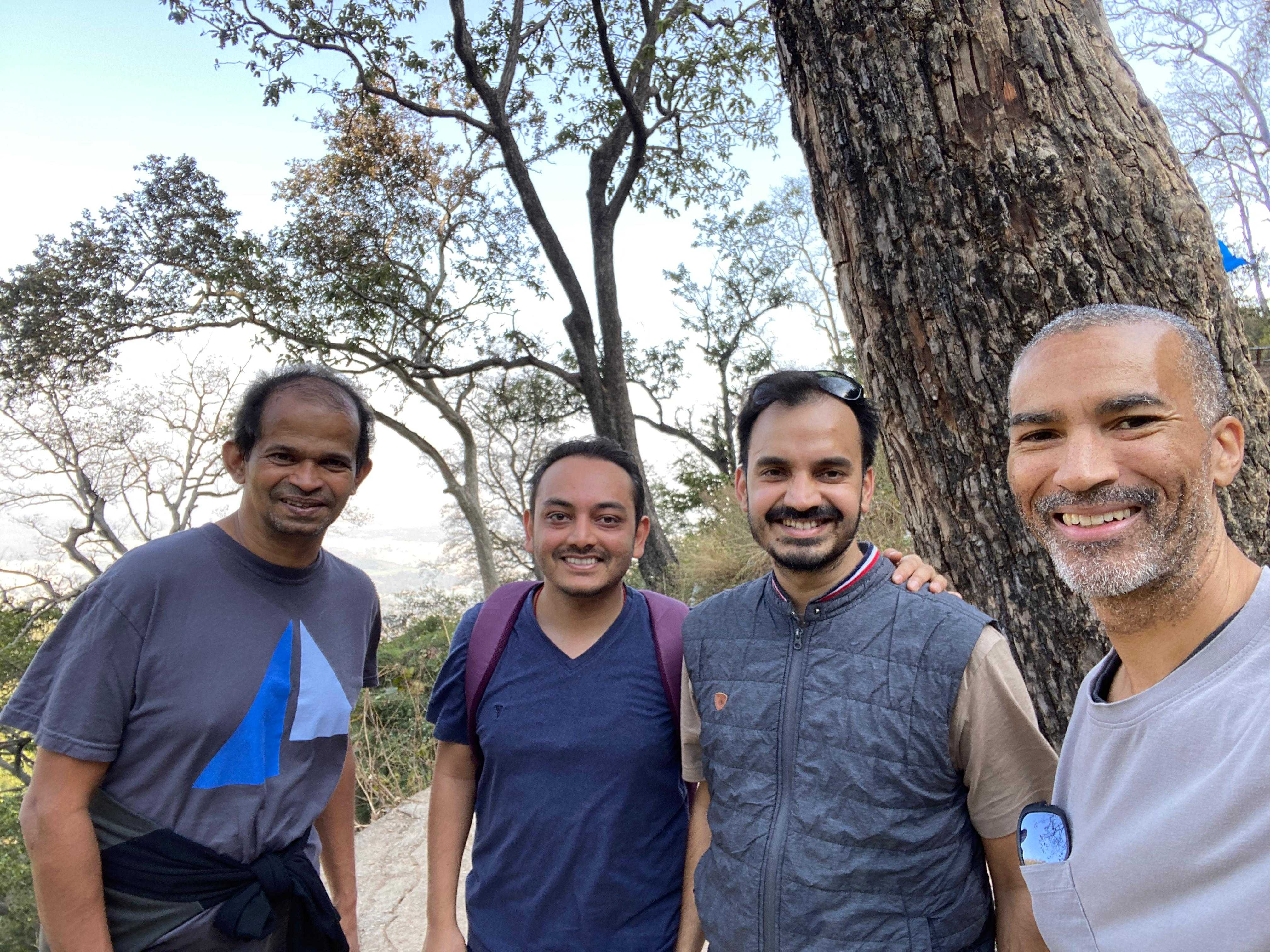
The next morning I had signed up for a hike to Neelkanth Hill in Rishikesh. We booked a cab, which ended up taking us very near to the summit. Due to time constraints we decided to just do a short ascent and descent all the way down the hill.
I do regular hikes, treks and walking but the pace set by my fellow trekkers Lobo, Jerome and Karthikeya was too quick for me to keep up. They did pause their relentless hike occasionally, to let me catch-up to them and after about half an hour or so, to my relief, we started our joyous descent. The trail was mostly empty, which gave us time to enjoy the hike discussing
- AI use for development, how life has changed for a developer
- Leveraging AI within platforms like Glific or Avni
- Block-chain technology and its application for the development sector
Review of Avni AI journey and the path ahead
Lobo and I also touched-base upon what Avni team planned to do as part of Cohort 2, and what the outcomes were from the previous cohort.
I conveyed that, adopting AI for implementation work had helped us drastically reduce Onboarding cost for organisations and doing field-visit during UAT phase had helped shorten the go-live time for new implementations.
We discussed the 3 user journeys once again and he provided inputs on how the Field worker use-case where we planned to embed ML models within Avni for Conjunctiva scan or Medical application seemed like a bad idea, as it was not our area of expertise.
I also asked him for inputs on Speech-to-text transforming in Avni and he raised Privacy concerns, which Vinay from our team had also raised during our internal discussions.
Finally, we did seem to agree that leveraging AI for App Configuration and Creation of Reports and Visualization to enable Self-service users seemed the best bet, as part of this AI Cohort.
Return to civilization and Overtaking cars on foot
After close to 2 hours since we began the hike, we finally returned to civilisation and the madness started all over again. We rode a cab to close to a KM from our hotel, and then did a final sprint by foot to the hotel as we seemed to be stuck in a crawling traffic, overtaking cars on foot.
Good food, Fun and Laughter
After a quick shower and check-out from the hotel, few of us from the Cohort went to Tattv Cafe in Tapovan. We had some fabulous desserts and Italian food, discussing our journeys in the development sector so far and quirks of few of our team-mates, which drew some hearty laughs. Soon it was time to start our return journey back home, having laid a solid foundation for AI adoption within our products for this year.